Rules for Salespeople
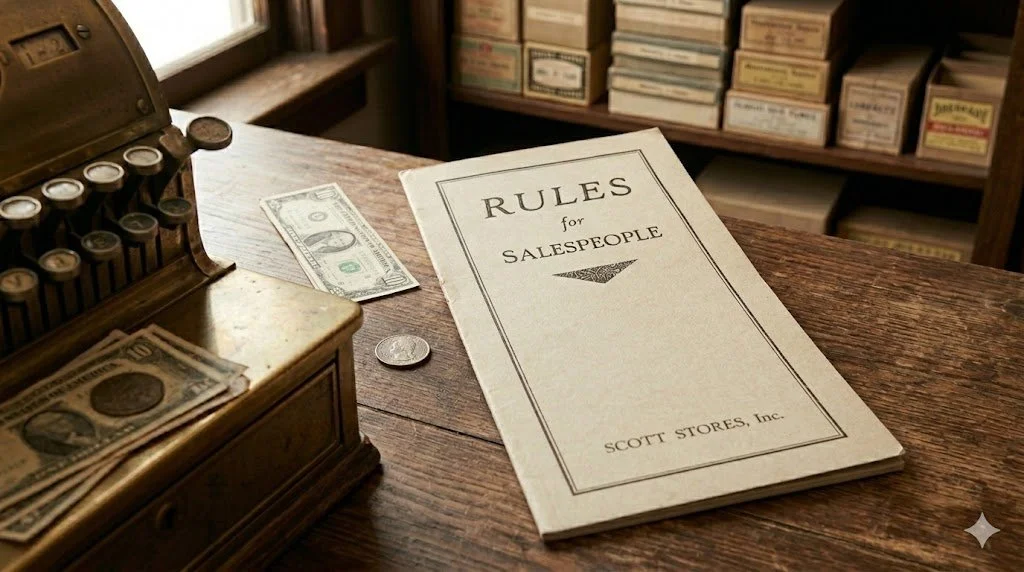
This is the employee booklet my father saved from 1929. I took a straight-on picture of it which AI incorporated to create this image of a 1920s store in just a few seconds.
Like his father before him, my father ran a small-town general store. Bud Dryden was born in 1907. Though he went to college, something few of his contemporaries in rural America did in those days, he dropped out sixteen credits short of graduation. Bud didn’t see that the history, political science and English literature classes he had taken could have any effect on his future. He wanted to learn something more practical — how to be a merchant. And he knew he needed to learn from someone other than his father, who had been running his store much the same way since the 1890s.
A few weeks after his twenty-second birthday, Bud landed a job as a management trainee for Scott Stores, Inc., a Chicago-based chain of “five and dime” variety stores. Scott sent him to its Helena, Arkansas, store in October 1929, the month Wall Street laid an egg. Nobody knew it then, but they’d find out quickly—the Great Depression had begun.
Meticulous and thorough in everything he did, Bud kept a notebook detailing key lessons he learned at Scott’s: how to open and close the store, how to build eye-catching displays, how to evaluate job applicants, how to take inventory, handle returns, damaged goods, and much more. He kept his notes in a loose-leaf binder my siblings and I found in a box of his things nearly fifty years after his death.
In the same box was a six-page pocket-sized booklet entitled “RULES FOR SALESPEOPLE.” Store managers were expected to hand it to all new salesgirls. How do I know the salespeople were all female? I just do, and you will too once you read it, because I’ve included every word of the booklet below. Though it was written nearly a hundred years ago, “Rules” should be required reading for anyone who works in a customer service role in any store, anywhere—not that the clerks, managers, or executives of today’s big box stores give a damn about customer service anymore.
I invite you to take a few minutes, go back in time nearly 100 years, imagine you’re starting your first day as a variety store clerk, and read what’s expected of you.
_________________________
(Introduction)
The object of these Store Rules is fourfold; to protect the interest of (1) customer, (2) employee, (3) the Company, and (4) to profitably increase the sales of this store. Certain rules are always required in a large organization. These rules will not be difficult for anyone who gives his or her loyal best. We wish it distinctly understood that employees and customers shall at all times receive courteous consideration. Treat every customer as though they were going to spend $25.00 at your counter.
Rules for Salespeople
1. Promptness is essential. Be in your place every day on time.
2. Leave your purse and personal belongings in the locker room. If you desire to leave your counter, secure the floor man's permission. Never leave your counter unprotected.
3. Dress plainly, avoiding party dresses or loud colors. Smocks will be provided you at a nominal cost.
4. Chewing gum, loud talking, undue gossiping and talking across aisles are not tolerated during business hours.
5. Promptly notify the office when you are absent.
6. The standard Scott Stores greeting to your customers is, "May I wait on you, please?" Use no other salutation! Always say, "Thank you" (and mean it) when handing package to customer.
7. Every package must be wrapped before delivery to customer. If he, or she, desires an item unwrapped, notify floor man. Wrap parcels neatly, quickly, and economically. Use bags whenever possible being sure to use the proper size.
8. Crockery, china, glassware, light bulbs, and other fragile merchandise must be carefully tested and inspected before wrapping. Wrap with extreme care to avoid breakage by customer.
9. Be sure you are selling the merchandise at the right price. If in doubt, don't guess, call the floor man.
10. Exchanges, refunds, complaints — are to be handled in a courteous manner. Refer customer to floor man.
11. During busy periods wait on customers in order of their arrival. If busy with one customer, and second has selected merchandise desired, and has money ready, excuse yourself to first customer and promptly serve second customer..
12. Inspect all money carefully. Test coins on Marble Slab of Register. Call floor man if slick or counterfeit money is offered you.
13. The "NO SALE" key is rung only by permission of the floor man.
14. When change is needed or floor man wanted, call your department number.
15. THINK! Count money carefully when received, registered, and change counted back to customer, then wrap package. This will avoid cash register errors and disputes.
16. Know the lines of merchandise we carry so you can properly direct inquiring customers, and make extra suggested sales. If uncertain, call the floor man. Know everything possible about your particular department. BE A SALESWOMAN not a clerk..
17. Keep your counters filled at all times with a complete assortment. NEVER LET ANY ITEM BE OFF SALE, especially a checking item or a fast seller..
18. Spend your spare time cleaning your merchandise, counters, understocks, back section, etc. Idleness indicates an indifferent girl or too many girls employed. UNDERSTOCKS ALWAYS LOW. CLEAN, CLASSIFIED AND NEAT. Soiled signs and dust on counters are considered “crimes. (Note: "Understock" refers to the backup inventory kept in the cabinets directly beneath the display counters).
19. At closing time your counter should be in first class shape — ready for the following day's business.
20. Merchandise for store use is to be taken ONLY WITH PERMISSION from the manager or floor man.
21. Soiled, broken, or damaged goods must be called to the attention of the floor man at once. FIGHT SHRINKAGE every minute. Sell oldest merchandise first.
22. Under no condition, are you to accuse a customer of shoplifting. If you notice shoplifting, notify floor man at once, without arousing suspicions of suspect.
23. Change, purses, valuables, packages, etc., left by customers must be promptly turned over to floor man. Refer all claimants to office.
24. Clerks' purchases: Your floor man will explain the procedure involved.
25. Neatness, promptness, cheerful service to customers; honesty; willingness to learn (and accept criticism); the desire to cooperate with your associates, and a moderate amount of hard work will assure you of preference in promotion.
26. The Scott Stores must be first in Service, Values and General appearance in this town. YOUR CO-OPERATION WILL HELP ACHIEVE THIS GOAL.
SCOTT STORES, INC.
_________________________
In the spring of 1930, six months after he joined the company, Scott decided to shutter dozens of its stores, including the one in which Bud was training. The Depression was on; the writing was on the wall. Scott had no need to train any young men to run its stores because it wasn’t going to be opening any. The start of the Depression was the beginning of the end for Scott Stores, Inc.
Bud found himself back in High Hill, Missouri, working at his father’s store, but his time at Scott hadn’t been wasted. He had learned a great deal. And he started dreaming about his own store which, three years later, he would open in Davis, Missouri —a tiny town that you’ll no longer find on any map because, like helpful, friendly, knowledgeable sales clerks in today’s big box stores, it no longer exists.
